The pair takes Billboard out to Status Hollywood in L.A.
Watch Sean Paul Rate L.A.’s Jamaican Food With ‘Love Island’ Star Chelley on ‘Take Us Out’


Seattles Premier Silent Disco Headset Rental Company
The pair takes Billboard out to Status Hollywood in L.A.


SixDegrees.org unveiled a sneak peek of the six inaugural Purpose, Produced campaigns in a fireside chat with founder Kevin Bacon to close out opening day on Advertising Week New York’s main stage.

Support the stream: https://streamlabs.com/steveaoki

Rebellion Records, the independent label co-founded by artist and CEO Michael Turner (PLVTINUM) and manager/COO Daniel Nall, has entered into a multi-million dollar partnership with music technology company Too Lost. This article was created in collaboration with DMN partner Too Lost. The deal will combine a significant capital investment with Too Lost’s distribution and rights […]

Soubeiran & Flavian Lovo – Por Nada out now on Ultra Records! Stream/download: https://lnk.to/soubeiran-por-nada Official Audio for “Por Nada” by Soubeiran & Flavian Lovo Follow Us: https://ultrarecords.komi.io/ https://www.youtube.com/@ultrarecords https://discord.gg/ultrarecords https://www.twitter.com/ultrarecords https://www.facebook.com/ultrarecordsofficial https://www.instagram.com/ultrarecordsofficial/ https://soundcloud.com/ultrarecords https://open.spotify.com/user/ultramusicofficial https://www.ultrarecords.com


Why buy a quirky ‘80s-style wavetable hardware synth in 2025 when there are so many powerful soft synth alternatives? In short: breathtaking sound quality.
In 2006, Native Instruments’ Massive elevated wavetables from the role of 1980s supporting player to the main star. Over the last two decades, the sample-adjacent synthesis architecture has continued to dominate electronic music production, with increasingly better-sounding algorithms and ever more creative ways to mutate waveforms emerging online every few years.
With producers often on the lookout for the next best thing, is there any point in going backwards in tech time and re-exploring wavetables as they were first developed by synthesiser genius Wolfgang Palm in the late 1970s? Yes, for a number of reasons, the biggest one being 3rd Wave, which not only recreates the tech of Palm’s PPG Wave but adds to it with a number of different sound engines, including modern wavetables, virtual analogue, and samples, making it something akin to a hardware version of Arturia Pigments.

Still not convinced? The 3rd Wave is one of the best-sounding synthesisers on the market today – of any type. It’s also pricey. To address this, its maker, Groove Synthesis, has just released the 3rd Wave 8M, a more affordable desktop version that loses some of the controls and voices but none of the synthesis power.
Groove Synthesis 3rd Wave 8M: The Affordable Model
The smallest and least wallet-bothering of the three 3rd Wave models (there’s also a larger desktop version alongside the flagship keyboard), 3rd Wave 8M pulls off the neat trick of reducing size, number of controls, and voices to reach that lower price point without sacrificing anything that makes the 3rd Wave so special.

You still have the same synthesis structure, the same three oscillators, the same dual filters, one of which is analogue. You get all of the modulation options and mod matrix. Also, the effects section, the sequencer and arpeggiator, all three of which are per layer. Although there’s more button-pushing now than before due to the reduction in knobs, menu diving is kept to a minimum. And, to make the experience more fluid, Groove Synthesis has increased the size of the screen to seven inches and added two more soft knobs for operation. This makes working with wavetables and wave envelopes a snap, concepts that might be difficult to understand without the clear visual reference.
Of course, not everything could complete the transition from massive keyboard to desktop box, and Groove Synthesis has had to sacrifice voice count (from 24 to eight) and layers, reducing timbrality (and associated output jacks) from four to two. Everything else is the same, though, on this stereo synth, and presets are compatible across all models (minus the additional two layers, of course). To the company’s credit, it’s managed to create a full and powerful instrument that remains a 3rd Wave machine and never feels compromised or hobbled despite the smaller size.
Working With Wavetables
Development of the 3rd Wave began when Groove Synthesis’s founders decided to explore the technology of the PPG Wave. If you’re unfamiliar with the original Wave, Wolfgang Palm’s big blue synth used wavetables as oscillators and gave the rest of the instrument a subtractive synthesis signal flow, complete with an analogue filter and traditional modulation. If you only know wavetables from modern software implementations like Massive or Serum, or even recent hardware like the Hydrasynth from ASM, you may find Palm’s implementation of the technology baffling. Groove Synthesis has carried this over into the 3rd Wave, so be prepared to check the manual to figure out what’s going on. Thankfully, the manual is extremely well-written and, with the occasional glance at the 8M screen, you should soon get the hang of Wolfgang’s weirdness.

A wavetable is a wavetable, however. That basic building block remains the same whether you’re programming a PPG Wave, 3rd Wave 8M, or Serum. It’s the way that you work with the wavetable that changes. Think of it as a long sample that gets broken up into individual waveforms (64 in the 3rd Wave, 256 in Serum). You can see all of these waveforms displayed on the 8M screen, laid out end to end. The wave envelope, a six-stage linear envelope with time and position settings for each point, determines how the machine moves through the wavetable. Rather than scan through the wavetable smoothly, you can set it, for example, to rush to the first chosen frame (called an offset in the 3rd Wave), then leisurely progress to the next, etc. It’s a different way to think about wavetable synthesis that can yield some interesting and unusual results.
 Let’s Go Wave Surfing
Working in tandem with the wave envelopes (there’s one per oscillator, meaning each oscillator can have its own sense of movement), you also get the Wave Surfer, a parameter that gives you the power to scroll through all three oscillator wavetables simultaneously, either manually or by setting modulation.
Set how the engine interpolates between waveforms in a table via the Wave Flow function. Turn Flow on for smooth transitions, or off to yield dramatic jumps. Wave Flow also gives you control over waveform smoothing for reducing aliasing on the classic 8-bit PPG Wave wavetables. Turn on smoothing for a more modern sound.
Lastly, the 3rd Wave instruments allow you to generate your own wavetables using the onboard Wave Maker. There’s an audio in jack for recording any sound you like. You can also import samples. In a nod to modern producers, the 3rd Wave will also take Serum wavetables or any that you’ve already made yourself.
Modern Wavetables and Other Engines
The 3rd Wave 8M is more than just a PPG clone, though, offering a separate bank of modern and beautiful 96kHz wavetables. If you can’t get enough of ‘80s digital, there are also two wavetables based on the Sequential Circuits Prophet VS waveforms. Turn off the wave envelope to run these as single-cycle waveforms, as on the original VS. You can actually do this with any wavetable, which is a neat way to access the grungy analogue waveforms tacked on to the end of the original PPG Wave tables.

If you’d rather work with clean analogue waveforms, turn to the virtual analogue engine to access one of seven shapes, including the usual sine, square, triangle and pulse, along with supersaw and noise types. These are uniformly beautiful and really expand the synthesis power of the 8M. Layer a sine under a wavetable for extra bass, or thicken out a pad with a saw.
The last piece of the synthesis puzzle is sampling. A recent addition via an update, it adds yet another stratum of sonic possibilities to the instrument. More than just a sample player, the 3rd Wave 8M is a true sampler, with not only USB import but also audio-in sampling, plus a sample editor as part of the operating system. The instrument offers 3.3MB of storage, giving you 35 seconds of sampling time at 48kHz, although it can go down as low as 10kHz, with 16-,12-, and 8-bit formats also possible. You’re limited to mono samples, unfortunately, although the unit itself is in stereo with pan spread and effects to widen the soundstage.
Lastly, we should mention that the oscillators allow more than just waveform or sample playback, with linear FM, oscillator sync, and a unison mode to play with.
Analogue Filter and Modulation
Like the original PPG Wave, the 3rd Wave 8M features a subtractive-style synthesis signal flow that, like the original, passes through an analogue lowpass filter. This Dave Rossum-designed 24dB/Oct resonant filter is just gorgeous and really thickens up the sound, especially when you get filter drive involved. Unlike the classic ‘80s synth, though, the 3rd Wave gives you a second filter, a digital emulation of the Oberheim state variable filter, placed in series before the lowpass. With its continuous lowpass, notch, and highpass structure, plus switchable bandpass, this can help shape the sound even more.

In terms of modulation, the 3rd Wave 8M is especially well-equipped, with dedicated envelopes for the amp and filter, two additional loopable envelopes, four LFOs, and that modulation matrix, which lets you route anything to, well, anything. Add in MPE support and you’ve got a seriously powerful synthesiser on your hands.
Surfing the Waves: How it Sounds
All of these parameters would be academic, though if the synthesiser didn’t sound so good. It’s seriously one of the best to come out within the last decade of any synthesis type, analogue or digital. The 3rd Wave 8M is deep and rich, with plenty of texture from the grungy old PPG wavetables when you want it. It excels at pads and leads, particularly ones with lots of motion, though it can do anything you need it to, really, even realistic acoustic sounds thanks to the sampling engine.
Here’s a selection of sounds on the 3rd Wave 8M that show off its various functions.
Layered pad with plenty of wavetable motion:
Roland Juno-style pads courtesy of the virtual analogue engine:
A buzzy organ that can’t sit still:
Showing off the sound of wavetable interpolation:
Price and Competition
So, is the 3rd Wave 8M for you? Although this new variant is the most affordable of the three models, at around £1800, it’s still not cheap. While it is pricey, keep in mind that the build quality on the 8M is superb. It feels solid (like the proverbial tank), and the screen really is something to behold. What could have been a negative – that is, losing the front panel real estate and knobs – has been turned into a positive, at least for this reviewer. Nothing feels compromised in the 8M. It’s a solid bit of kit through and through.
If, however, you’re after the Serum experience, this may not be the synthesiser for you. ASM’s Hydrasynth models are all excellent (we reviewed the desktop back when it came out and loved it). You can get the Hydrasynth Deluxe (complete with 73 keys) for less than the 8M.
Ultimately, the decision will come down to how much you love the sound of 1980s wavetables. If Depeche Mode and other synth pop groups form the basis of your sound, the 3rd Wave 8M is the current ultimate expression of what you want. The fact that it also has additional sound engines, a wealth of modulation options, and a sound that is sweet enough to cause tooth decay is all the more reason to check it out. It will have you wondering how you ever got by with in-the-box wavetables.
More information at the Groove Synthesis site.
[rating buy=”Groove Synthesis 3rd Wave 8M” price=”£1800″ link=”https://groovesynthesis.com/8m/” build=”5″ value=”3.5″ versatility=”4.5″ sound=”5″ ease_of_use=”4.5″ overall=”4.5″ text=”The gorgeous wavetable synthesizer made smaller and affordable but no less beautiful.”] [social-links heading=”Follow Attack Magazine” facebook=”https://www.facebook.com/attackmag” twitter=”https://twitter.com/attackmag1″ instagram=”https://www.instagram.com/attackmag/” youtube=”https://www.youtube.com/user/attackmag” soundcloud=”https://soundcloud.com/attackmag” tiktok=”https://www.tiktok.com/@attackmagazine”] [product-collection]

The influential producer will tackle love, loss and letting go in “undux,” his 10th studio album.
The post Kaskade Announces First Studio Album in a Decade, “undux” appeared first on EDM.

ABOUT THIS PLAYLIST A playlist dedicated to music that sounds like Warpaint.
The post Music That Sounds Like Warpaint : Spotify Playlist [Submit Music Here] appeared first on Soundplate.com – Record Label & Music Platform.

Native Instruments has introduced the Traktor MX2, a next-generation 2-channel DJ controller aimed at DJs of all levels. This is the first Traktor controller that we’ve seen in years – the renewed Z1 and X1 being the most recent. The aesthetic of the Traktor MX2 (fairwell, “Kontrol”?) matches those releases design language. This new controller […]
The post Traktor MX2: Native Instruments’ New 2-Channel Controller appeared first on DJ TechTools.
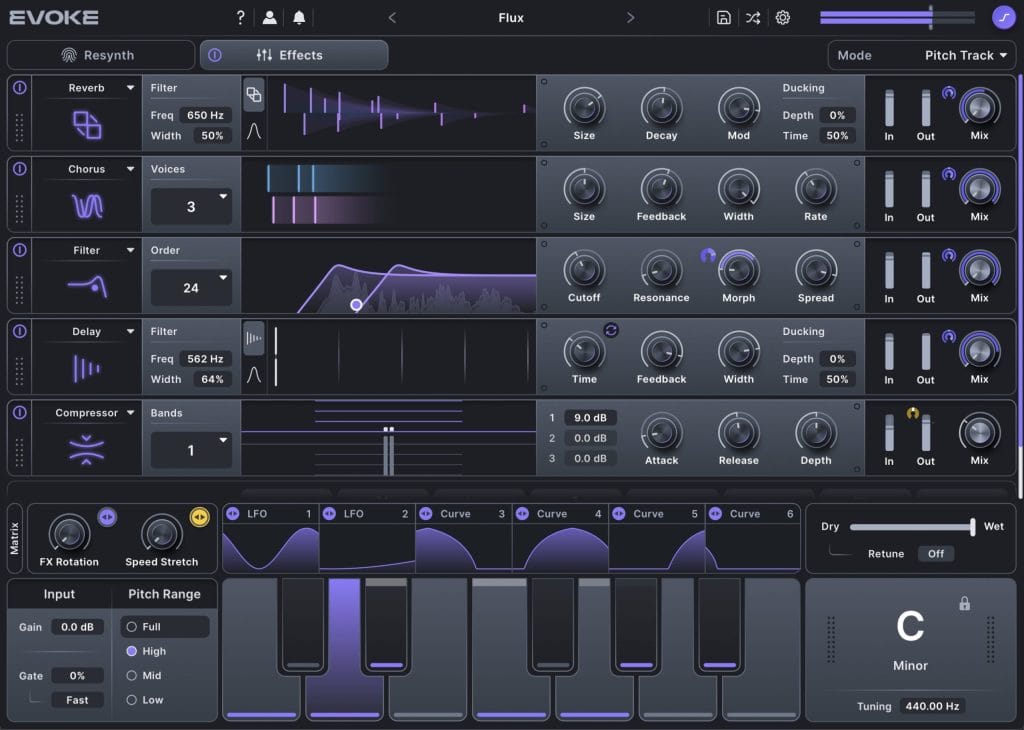
Minimal Audio has never been shy about bending sound design into new dimensions, and with Evoke, the company’s latest release, they’ve turned their gaze toward the human voice itself. Launched last week, Evoke is a hypermodern vocal processor that fuses vocal modeling with spectral resynthesis, offering an entirely new way to transform, harmonize, and animate vocals in real time. […]
The post The Creation of a Next-Generation Vocal Transformer: A Conversation with Minimal Audio appeared first on Magnetic Magazine.