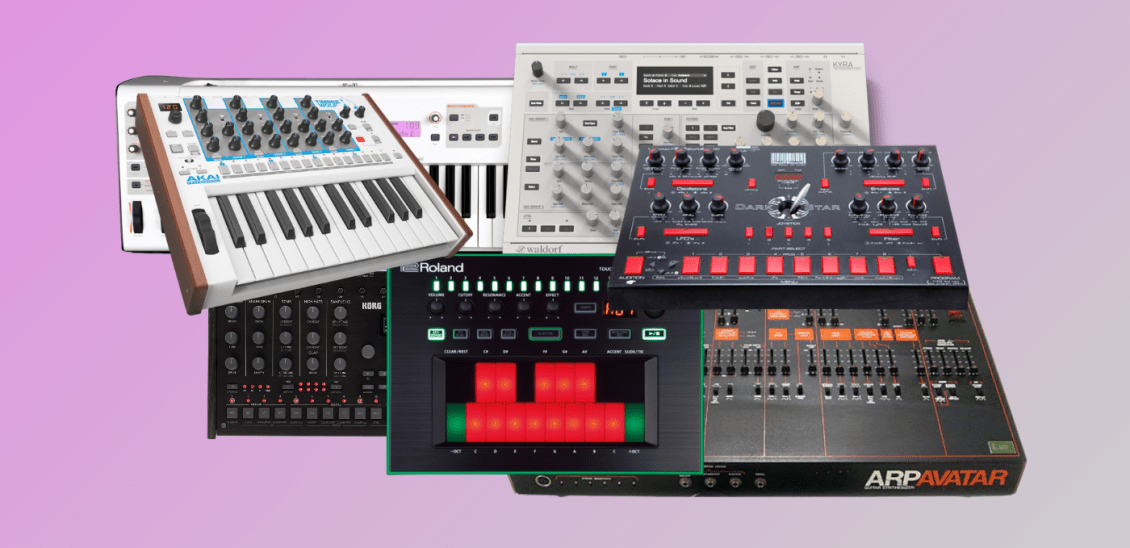
Not every synthesiser, drum machine or DJ controller can be a home run. Here are the ones that didn’t make it, the total disasters.
It must be difficult to be a gear manufacturer. You work so hard and for so long on a product only for it to die a miserable death once released into the world. Of course, sometimes you knock it out of the park and the synthesiser, drum machine or DJ controller becomes a beloved favourite. But not every time.
Today, let’s celebrate the ones that didn’t make it. The gear that swung for the bleachers but ended up as a pop fly. We should say, however, that just because a piece of gear doesn’t sell, that doesn’t mean it’s bad. It could be a victim of bad timing – either too early or too late – or it just missed the mark and wasn’t what people wanted.
Here are 10 pieces of gear that were a total disaster, the ones that the manufacturers would probably like to forget.
Akai Professional Timbre Wolf
It’s not often that a synthesiser is hated even before its release, but that’s just what happened with the analogue Akai Professional Timbre Wolf. Announced as the keyboard version of the ill-fated (and eternally out of tune) Rhythm Wolf, the world was ready to hate on the Timbre version before it even arrived. And hate it did, with the instrument’s NAMM debut only confirming for many how bad it was going to be.

It’s a shame, as it has a fairly unique synthesis architecture. Polyphonic with four voices that can be tweaked separately, you can use it as a four-oscillator monosynth, in unison, or as a polyphonic synth, with a Korg Mono/Poly-like round robin mode that cycles through the four voices. Unfortunately, the knobs are on the unresponsive side, the resonance craters the volume at high levels, and the tuning adjustment only works for detune in unison mode; you can’t create chord tunings across the voices.
And then there’s the sound, which is polarising to say the least. Some call it a classic ‘70s analogue sound while others compare it to farts.
Best comment: “The Timbre Wolf sounds like it’s being played from inside a garbage bag that’s sinking to the floor of the ocean.” (Reddit)
ARP Avatar
Ah, the synthesiser that sank ARP. At one point in the early 1970s, ARP and Moog were neck and neck in terms of sales. Its Odyssey and 2600 synths were (and still are) classics, and the company had plenty of other products out too that musicians of the time couldn’t get enough of.
 Credit: Vintage Synth Museum
So what happened? Unfortunately, ARP decided to dump $4 million into R&D for the 1977 Avatar, a groundbreaking guitar synthesiser. Essentially an Odyssey in module form, it featured a six-way fuzzbox distortion unit and included a special hexaphonic pickup unit that players had to mount on their guitars. While by all accounts a great-sounding instrument – and popular with artists like Mike Rutherford of Genesis and Pete Townsend – it was too expensive for most musicians, and not popular with the guitar crowd. ARP lost a ton of money on it and went out of business a few years later.
Best comment: “It’s such a unique tone.” (Reddit)
Roland TB-3
Roland famously doesn’t chase ghosts, so when it finally gave in and announced a new TB-303, expectations were high. However, what we got wasn’t another silver box but a black device with a garish red and green touchscreen. Um, what?

Given that the original 303 was something of a total disaster itself, it tracks that its first official follow-up, the 2014 TB-3 Touch Bass, would be too. And it’s not like it sounds bad. It’s digital, yes (surely you gave up on hoping for analogue from Roland a long time ago?), but it can do a decent 303 and some other sounds as well. And, if you have an editor, you can unlock some hidden features as well.
Roland soon caved and released the TB-03, which looked more like the original and had the same controls, which is what everyone wanted in the first place.
Best comment: “It works. Is super user friendly. Looks weird.” (Reddit)
Korg Drumlogue
Korg’s Logue series has been largely successful, with the original Minilogue, its sequel the Minilogue XD, and the Monologue all popular instruments. So it made sense for there to also be a Logue-based drum machine with a similar combination of analogue and digital sound sources. Unfortunately, by the time the Drumlogue came out in 2023, people had largely moved on from the idea of an analogue drum machine and were much more into digital ones.

It also didn’t help that the Drumlogue did a lot of things but didn’t excel at any one of them. In our review, we noted that “it doesn’t do any one thing brilliantly but instead gives you a wide variety of sound synthesis and sequencing options.”
At more than £500, it was also on the expensive side. Korg tried discounting it last year, but due to an apparent lack of interest, it has now been discontinued.
Best comment: “It sounded like a wet fart.” (Reddit)
M-Audio Venom
M-Audio released its first synthesiser in 2011. Dubbed Venom, the name reflected the instrument’s focus on aggressive and gritty sounds. The problem with the Venom wasn’t how it sounded. Sound On Sound called it “an edgy, often unsettling instrument capable of ripping holes in mixes – and maybe your eardrums.” Cool if that’s what you like.

The main issue turned out to be the software, or rather the Vyzex editor, which you needed to run on your computer to gain access to many of the synth’s parameters. This is never a great idea, as even if the editor works well now, it will become useless within 10 years. Unfortunately, Vyzex never worked properly to begin with, leaving many frustrated and – in some cases – bricked out of their synths.
Best comment: “I can see why a lot of people hate the thing.” (Reddit)
Cheetah MS800
You may have heard of the Cheetah MS800, a wavetable-powered black box synthesiser module released in the early 1990s. That’s because the Aphex Twin used one for his Cheetah EP. Leave it to Richard to squeeze an entire record out of what is considered to be one of the most impenetrable synthesisers ever made.
 Credit: GForce Software
Fifteen-voice polyphonic, 16-part multitimbral with patches comprised of up to 14 wavetables, it certainly sounds promising. Then you realize there’s no filter. And even worse, it’s almost impossible to program. “Beyond daft? We think so,” said GForce Software, whose Chris Macleod was tasked with creating presets for it upon release. “Given its almost totally incomprehensible editing system, could it have been a contributing factor to Cheetah vanishing soon after the MS800’s release?”
Best comment: “The Cheetah MS800 remains the most difficult instrument to program on the planet.” (GForce Software)
Waldorf Kyra
In 2018, independent developer Manuel Caballero showed off a promising new synthesiser called the Exodus Digital Valyrie at Musikmesse. One year later, and with a new exterior design, the same synth made its debut at NAMM as the Waldorf Kyra. With many comparing it to the Access Virus, sales of the FPGA-powered virtual analogue synth started off strong – despite the high price tag of €1899.

However, things soon started to go wrong. Early adopters took to the Waldorf boards to complain of bugs, ones that the company never satisfactorily addressed. Rumours point to a disagreement between Caballero and Waldorf that prevented any changes from being made. Whatever the reason, Waldorf quietly ended production of the Kyra last year, leaving many frustrated and upset.
Best comment: “What a pity and a waste that Waldorf abandoned development of the Waldorf Kyra. Such a promising machine, with immense potential that will never evolve.” (KVR Audio)
Red Sound Systems DarkStar
Ah, the DarkStar. The synthesiser the internet loves to hate. If ever there was a poster child for gear that was a total disaster, this is it.

First released in 1999, this tabletop virtual analogue synth just looks weird, with a large joystick prominently placed right smack in the middle for mixing the oscillators and waggling the filter. The strange look of the synth is down to the company repurposing one of its DJ controllers for the job. This probably also explains the RCA-only jacks.
You could also get an upgrade kit to turn it into a vocoder, but why?
Best comment: “The worst synth I ever owned. I felt guilty about selling it because that meant I played a part in someone else’s disappointment.” (Modwiggler)
Novation Twitch
Just because it’s a total disaster that doesn’t mean it’s bad gear (right, Florian?). Take the Novation Twitch, for example. A solid DJ controller from an excellent company, Twitch got in trouble because it was ahead of its time. It lacked jog wheels, you see, and in 2011, this was too much of a departure from traditional DJing.

Those who did take a chance, though, ended up loving it, particularly the touch strip controls and slicer effect. Nowadays, DJing by triggering hot cues and effects is par for the course – just ask Native Instruments and its line of modular, jog wheel-less Traktor controllers.
With a lack of interest from general consumers (possibly hindered by limited software compatibility at launch), Novation soon dropped support for Twitch.
Best comment: “The Twitch is a huge departure from traditional DJ setups.” (Reddit)
Arturia Origin
Arturia is recognised as a hardware synthesiser powerhouse now, but back in 2009, it was still known primarily as a soft synth developer. Looking to change that, it released Origin, its first true hardware synth. A software synth environment in a tabletop box (and later a keyboard version), it gave users access to its many emulations but in a modular manner, letting you combine different synthesis elements together into Frankenstein-style classic synth creations, much like u-he’s Diva does today. It was also praised for its sound quality.

So why is Origin on this list of total disasters? It was too expensive. Debuting at around $3000 (with the keyboard version climbing to $4000), it was a steep hurdle for people who already knew how much the software cost. Many also complained about the menu diving and bugs.
Interestingly, Arturia recently released AstroLab, which has a very similar software-inside-hardware premise to that of Origin. Timing, it would appear, is everything.
Best comment: “I almost traded a Tempest for one. Thank the lawds I did not. It’s awful.” (Reddit)
[social-links heading=”Follow Attack Magazine” facebook=”https://www.facebook.com/attackmag” twitter=”https://twitter.com/attackmag1″ instagram=”https://www.instagram.com/attackmag/” youtube=”https://www.youtube.com/user/attackmag” soundcloud=”https://soundcloud.com/attackmag” tiktok=”https://www.tiktok.com/@attackmagazine”] [product-collection]