Cardi has the most diamond plaques of any female rapper, with four.
Cardi B Celebrates ‘WAP’ Going Diamond With Megan Thee Stallion: We ‘Really Did That’


Seattles Premier Silent Disco Headset Rental Company
Cardi has the most diamond plaques of any female rapper, with four.

The Descendants star is set to perform across North America to celebrate the release of her new EP.

I tested the Brightin Star 50mm F0.95 II, a full-frame manual focus lens for mirrorless cameras. Check it out here: https://brightinstar.com/collections/manual-focus-lenses/products/mf-50mm-f0-95-ii-full-frame-prime-lens?ref=sqgaynoh This is not the easiest 50mm lens to use. At F0.95, focus is incredibly thin, missed shots are part of the experience, and it definitely does not behave like a safe autofocus lens. But when it works, it has a look. In this video I share my honest experience using the Brightin Star 50mm F0.95 II for portraits, low light, and real-world shooting — not charts, not lab tests, just whether it gave me photos I actually cared about. Follow me – https://www.instagram.com/jaysoundo Subscribe for photography, gear reviews, behind-the-scenes content, portrait photography, sports photography, and creative projects. Lens: Brightin Star 50mm F0.95 II Mount tested: Sony E Mount Aperture: F0.95–F16 Filter thread: 62mm Minimum focus: 0.5m Weight: around 750g Disclosure: (Lens provided by Brightin Star / affiliate link) #BrightinStar #50mmF095 #lensreview Song: Free With You Composer: Danlsan Website: https://youtube.com/user/danlsan License: Free To Use YouTube license youtube-free Music powered by BreakingCopyright: https://breakingcopyright.com

It’s not often an instrument tells you what it is so blatantly. And perhaps there’s a reason for that, as SuperStarSaw is far more than the one-trick pony its name suggests.
It’s not uncommon for me to start a review with a disclaimer or controversial statement, so here goes: I really like SuperStarSaw… but not for its ‘super saw’ patches. And I’m not even sure that sound is the best reason to buy it. Still, let’s address the oscillator in the room…
Back in the mid 90s, a new kind of synth exploded into the market like a giant banging thing. Virtual Analogue used newly affordable digital chips to mimic older analogue synths… with more polyphony and stability.
And they offered new possibilities.
In 1996, Roland released the JP-8000. This pioneering synth featured a special oscillator slot, designed to stack up seven saw waves at wide detuning intervals.
This was possible because the JP-8000 featured dedicated computational headroom on the chip for seven saw waves in one oscillator slot, without taking away resources from the rest of the synth. Hence the name: supersaw.
It was thick, it was huge, and it came to define an entire era of trance music.
You could approximate supersaws in other VA synths by stacking up oscillators and voices and applying unison, but it wasn’t the same. And because competitors such as the Nord Lead, Access Virus, and Yamaha AN1X (the latter two of which I owned) didn’t allocate bandwidth for those extra waveforms, your polyphony tumbled fast.
And just one more thing to clarify before moving on… people often think ‘supersaw’ means a specific kind of patch. But it’s actually more useful to think of it as an oscillator type, as that’s how the JP-8000 treated it.
All of which brings us to SuperStarSaw.
What’s in a name?
The name is a pun, of course, which isn’t a good sine (see what I did there?).
SuperStarSaw revolves around supersaws and is designed by a producer who made his name with a track called Superstar (itself full of supersaws), who went on to work with superstars. Luckily, there’s more to this thing than wordplay.
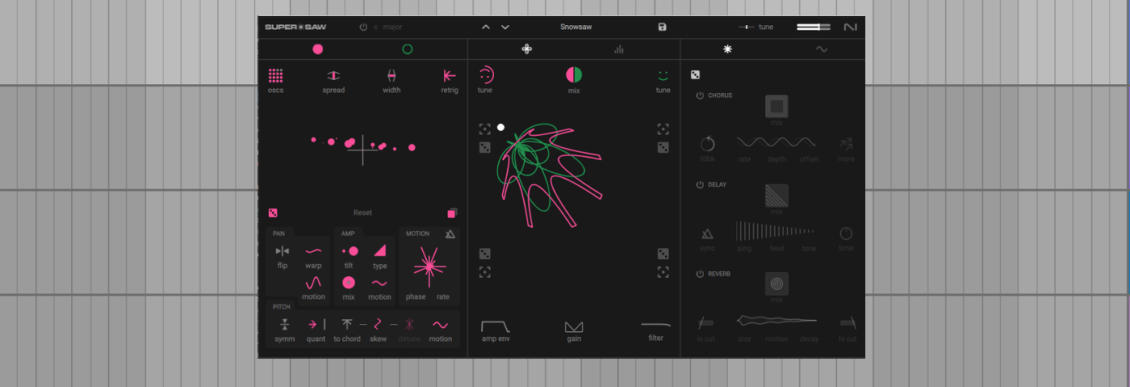
Structurally, SuperStarSaw is very straightforward. To the left is the sound window, containing two voices, called ‘swarms’. Each delivers up to 16 saw waves and, unlike classic supersaws, lets you manually alter things like the number of saw waves, their tuning separation, and stereo spread, with additional controls for retriggering per note, swapping oscillator panning, and more.

Underneath are a bunch of sound-altering controls. You can have ‘motion’ modulation of spread, tuning and even the non-linearity of the stereo distribution of the waves. You can create pairs of waves, affect the mix of a tuned saw wave and its relatively detuned siblings, introduce amplitude variations to oscillators within swarms… and that’s before we even get to ways you can affect the dynamic tuning of the oscillators within each voice.
If that feels a bit overwhelming, fear not: most modules in SuperStarSaw have a dedicated randomiser function. Plus you can copy your setup from one voice to another with a single dedicated button.
[quote align=right text=”People often think ‘supersaw’ means a specific kind of patch. But it’s actually more useful to think of it as an oscillator type, as that’s how the JP-8000 treated it”]
There really are oodles of controls for customising the oscillators, which makes me wonder if any of the online numpties I encountered complaining about SuperStarSaw’s lack of options have even tried it.
In the middle of the GUI are performance/morphing controls, letting you blend between the two voices and between four different customisable snapshots, for moving dynamically between four versions of the same patch.
Below that are some dynamic, gain and filter controls for both voices combined.
The other central tab relates to global voicing stuff like pitchbend, tuning, glide, and unison. Yes, you read that right: 32 stacked saw saves… plus unison. Your move, Tiesto.
To the right of the interface are one tab for effects (chorus, delay, reverb) and another for more conventional modulators (envelopes and LFOs).
So that’s the tour. How does it sound?
 There’s enough presets here to keep you going for a whileFiltering out the noise
In terms of the results, the range is actually pretty impressive – if you’re into in-your-face, electronic styles. I’ve seen a lot of reviews claiming it’s only for doing classic supersaw sounds, but I have to assume they haven’t gone through the presets… which are great. Will it replace Serum as your do-anything synth? No, but that’s not the point. And what’s here is far more varied than internet reports would suggest.
In fact, there’s even often a touch of the Diva about a number of them, particularly when it comes to some lovely 90s-era Strictly Rhythm-esque deep chord hits – check my little house demo jam below, made entirely using SuperStarSaw and a few drum samples. And it does its own cheeky take on Reese Bass and hoovers too.
Another line of Attack (NI aren’t the only ones who can do wordplay) has been to criticise its limited programmability, and I’m torn. If you’re talking about signal routing and general architecture, that’s factually correct. But it’s also misleading.
When you have such a highly specialised interface and control concept, it’s perfectly understandable to impose an architecture tailored for that. To complain feels like moaning that your new dirtbike doesn’t have air-conditioning and attachment points for a bucket seat.
SuperStarSaw sometimes frustrated me a little, though. For example, having to hit (quite faint) buttons to switch views. Case in point: when sitting down to write this review, I spotted something in my first impression notes: “conventional amp and filter envelope controls would be nice”.
[quote align=right text=”Ignore the naysayers and don’t be deterred by the ‘supersaw’ label”]
I eventually came across some conventional amp and filter controls, but the fact that I didn’t spot them in the first half hour underlines my gripe.
And, judging by comments online, I’m not the only person who likes the synth but finds the interface a little clunky. I saw feedback like “no double click to reset parameters to default” popping up, and there’s some merit to those gripes. I’m also a plus one for a resize the GUI option, which currently is not available.
That said, predictably, as with any new instrument from one of the biggest names in music production, I’ve seen a few people online trotting out yet another remix of “This is rubbish because NI… ” in YouTube comments.
One asinine critique was that ‘you can make the same sounds in Serum’. To which the obvious answer is ‘you can make a version of most sounds in most big soft synths these days, but there’s far more to synth programming and composing than copying other patches’. It’s quite a misinformed gripe too, as while you may (or may not) be able to make a given static patch in Serum… 1. You probably wouldn’t and 2. You certainly couldn’t perform/morph it in anything like the same way.
Another while-Rome-burns-worthy debate for our challenging times was whether or not SuperStarSaw sounded exactly like a Roland JP-8000. To which the even more obvious reply should be ‘Who cares?’. Moreover, I suspect most of the people claiming it doesn’t (probably without having owned either the hardware or software) weren’t even born when the original Roland machine dropped.
By contrast, as somebody who not only used a Roland JP-8080 (rackmount JP-8000) back in the day, but even used an actual supersaw on a 12” EP (called Super Saw), I had a great time with this thing.
Speaking of that Super Saw track, if you ever doubt the maxim ‘vinyl cannot handle stereo bass frequencies’ then you should ask the poor cutting engineer who broke two expensive master lacquers (three hundred quid’s worth in 1999) before realising that his idiot clients had handed him a DAT with the widest stereo organ patch our JP-8080’s digital effects section could deliver.
That was the day we learned about multiband mono-ing and mid-side processing.
A synth by any other name
So, it’s decision time. And if your question is ‘Should I buy SuperStarSaw?’ then my answer is: If you like dance music genres or active dynamic modulations, yes.
Ignore the naysayers and don’t be deterred by the ‘supersaw’ label. It conjures impressions of brash, annoying, EDM, or the kind of formulaic late 90s trance that made me pray for tarantulas to stuff my ear canals with eggs every time the DJ playing before me would drop Sandstorm.
“What’s in a name?” asked Juliet, in Shakespeare’s classic. She was lamenting the fact that Romeo was off limits for no other reason than his name. And I can’t help feeling her pain. Because there’s a lot more on offer here than classic supersaws.
SuperStarSaw is available from Native Instruments.
[social-links heading=”Follow Attack Magazine” facebook=”https://www.facebook.com/attackmag” twitter=”https://twitter.com/attackmag1″ instagram=”https://www.instagram.com/attackmag/” youtube=”https://www.youtube.com/user/attackmag” soundcloud=”https://soundcloud.com/attackmag” tiktok=”https://www.tiktok.com/@attackmagazine”] [product-collection]

Twinsick, NONONO – Pumpin Blood ❄️ Chill Nation Spotify: https://chillnation.ffm.to/chillspotify Track link ↪︎ https://on.soundcloud.com/KKrtZxKubXHdleRcuZ ♫ Follow Twinsick https://soundcloud.com/twinsick https://www.instagram.com/twinsick/ Artwork by ↪︎ https://unsplash.com/@colefreeman ♫ Support Chill Nation http://instagram.com/chillnation http://soundcloud.com/allchillnation

The country hitmaker has teamed up with Shiner for a collaboration inspired by her Billboard 200 chart-topping album.

The Princess of Pop also shared a video of herself dancing to Rihanna’s music.

Fans shared their dismay online, revealing that several ticket holders had received refunds for their purchases without reason over the weekend.

how to go viral as a producer without bots or begging. Try sharper clips, smarter drops and release habits you can test this week.
The post How to Go Viral as a Music Producer Without Fake Hype appeared first on The Ghost Production.

Summer Chill 2026 Deep House Follow ChillYourMind on Spotify: https://open.spotify.com/playlist/7wDZ5nB0Wb1tcoloILplN8 Subscribe & turn on the bell : https://www.youtube.com/chillyourmind Tracklist: 00:00:00 – joki – Golden Ticket (runaway) 00:03:07 – Wankelmut, James Hersey – Wish You Would 00:05:16 – L.B. One – Dance With The Devil (Ocean Drive) 00:07:48 – petit roi, Children of Jazz, Onur Yalcin – Jazzmania 00:10:06 – Mingue, Feeve, Cinema Kids – Spanish (Mi Amor) 00:12:23 – SRNDE – Glimpse Of Us 00:15:36 – Lust. – Can’t Go Back 00:17:44 – RAZZ, Angie Robba – City At Night RADIO FINAL MASTER 00:20:00 – lone tide – Can’t Go Back 00:22:11 – blaank & Mayvee – Know You 00:24:27 – Alex Breitling & Glowoko & LAURAm – Peace Again 00:28:18 – fwd/slash – Until We Fade 00:31:59 – Alberto Ciccarini & Poul & Lacey – Weightless 00:34:22 – Léne, ROBINS – Butterflies 00:37:00 – P.A.V – Need You Now 00:39:12 – Lust. – Cross Your Mind 00:41:18 – lone tide – Beautiful Silence 00:43:29 – LØST SIGNAL, Muffin, RIVIERA – Blue Eyes 00:45:40 – Thom Merlin – Deixa Vir 00:47:43 – RAZZ, KAYGE – Something Real 00:50:15 – SHOEN, Steve Pontex – The Unknown 00:53:29 – blaank & JEANS – Echo 00:56:21 – Panuma & Angie Robba – Strobe Lights 00:59:00 – Solayne & FARLEY – Already Gona Turn on notifications to stay updated with new uploads! Follow our playlists on: Spotify: https://open.spotify.com/playlist/7wDZ5nB0Wb1tcoloILplN8 Apple Music: https://music.apple.com/profile/chillyourmindofficial Deezer: https://www.deezer.com/en/profile/1756462062 Follow ChillYourMind Instagram: https://www.instagram.com/chillyourmind/ Discord: https://discord.com/invite/8xw6RQf Facebook: https://www.facebook.com/chillyourmind Soundcloud: https://soundcloud.com/chillyourmind X: https://www.x.com/chillyourmind Merch: https://www.shopchillyourmind.com #chillyourmind #chill #chillmusic