
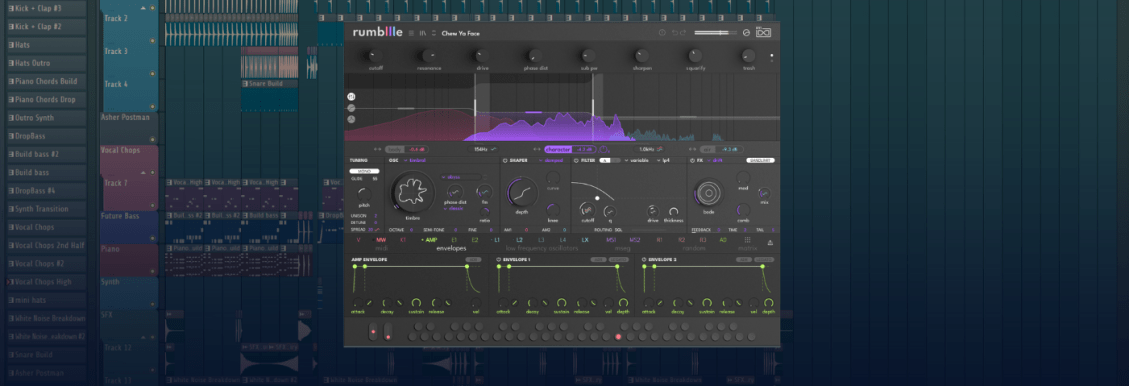

UVI suits up for the bass wars with Rumble, a low-end focused synthesizer that ingeniously splits every sound into three component bands. Is this enough to compete with established instruments like Massive?
UVI is known for a lot of things, chiefly sophisticated instruments like Falcon and incredible sound quality. Cutting-edge electronic music production tools, however, are not really something we associate with the French developer. That’s all about to change, as Rumble, the company’s latest instrument, is a bass-forward synthesizer that aims to take on the big-name players in the low-end game like Native Instruments’ Massive and Kilohearts’ Phase Plant.
Rumble has the sound quality, as you would expect. But it also brings something utterly unique to the (wave)table – and once you try it, you may not be able to live without it.
Rumble Overview 
Rumble’s big selling point is its three-band architecture. In much the same way that a kick designer separates percussion construction into three levels (sub, body, and transient), Rumble does a similar thing with bass building. It’s got three identical synthesizers, each with oscillator and distortion sections, a unified filter, and separate effects that pass through a multiband compressor with adjustable crossovers. This multiband stage allows you to design separate sounds in what UVI is calling Body, Character, and Air stages. It’s ingenious, and makes you wonder why it’s not standard on bass synths (you can bet it will be now, though!).
Each of the three synth engines is identical, so let’s look at what’s on offer.
First up is the oscillator section. This contains nine models, including virtual analog, wavetable, FM, sample-based, and other bass-focused engines. There’s even a kick generator for 808s and techno rumbles. With a name like Rumble, there had better be!
The oscillator then moves through a wave-shaper. As with the oscillator, this also presents a variety of different types. There are 10 distortion algorithms, to be exact, including clipper, sine, two foldback styles, noise, and more. Each also allows you to route amplitude modulation between the bands for extra crispiness.
You also get a per-band effects slot, with 10 types on hand that run the gamut from reverbs and delays to cabinet distortion, chorus, and more esoteric circuits like Neuro, which combines chorus, phaser and drive into a single spectral transformer. And, in keeping with the low-end theory of the instrument, these are all tuned for bass work.

Parked between the oscillator and effects stages is a global filter for processing all three bands into a single, cohesive whole. There are actually two filters here, with single, serial and parallel routings. The filter types themselves are a nice mix of traditional and modern, with Analog and Variable (the latter poached from the Oberheim XPander) sitting alongside Ripple, Swirl, Scream and Formant models.
As you’d expect from a modern bass designer, Rumble provides plenty of modulation possibilities. Using the now-standard Massive-style drag and drop system, it gives you ADSR envelopes, LFOs, MSEGs (Multi Segment Envelope Generators), random sources, and even analog drift for a dose of instability.
Lastly, the Master Section brings everything together with that multiband compressor. The compressor itself features eight different styles of dynamics control, from FET to OTT. You can also turn the compressor off and just use the bands as volume control. The crossover points are, naturally, adjustable. They’re also modulatable, which opens up all sorts of sound design possibilities. Each band can be independently panned, isolated, or even removed from the signal path. The Master Section also includes a four-band parametric equalizer and an on/off limiter at the output stage.
Lastly, there are 16 macros spread across the top for combining modulations and parameters.
[quote align=right text=”Rumble’s three-band architecture is ingenious, and makes you wonder why it’s not standard on bass synths”]
Rumble In Use: Sound Design 
All of these features come together to create bass sounds that are powerful, punchy and full of motion if you want it. Let’s hear Rumble in action.
Here’s a vintage-style synthesizer bass sound with juicy filter resonance. Let’s split it into its three components so we can hear them all separately.
First, the sub, or what UVI calls Body:
Next is the midrange Character:
The Air:
And now altogether:
Rumble can do all manner of modern bass sounds, including Reeses. This Reese uses the Analog oscillator for the Body and Air, and Timbral wavetable oscillator for the Character band.
Reese power:
Rumble can also drone. This bass drone features wavetables in all three oscillators.
Droning Rumble:
The Low Down: In Conclusion 
There’s a lot to like in Rumble. It’s very easy to whip up powerful and punchy bass sounds, and the three-band layout ensures that any sound will be well-represented across the frequency spectrum. And, as you’d expect from UVI, the sound quality is impeccable.
Rumble is also incredibly intuitive. Everything is where you expect it to be, and assigning modulation is as easy as dragging and dropping. And, if things get too complex, the modulation matrix page makes a handy visual guide.
This is an amazing start but there is more that we’d like to see. Modern bass sounds need to be both mono-safe and ultra-wide, and Rumble could offer more in the way of imaging options. Right now, you can choose monophonic, polyphonic or unison for each layer, and by playing with unison spread in the Character or Air bands you can get some cinematic sounds but proper non-unison stereo spread and mid/side options would be nice to see, as would a mono option, at least for the sub Body band.
The compressor could also be more robust. As it stands, there’s no attack, release or threshold, just gain amount. Or, let us route the bands out of the synth so we can process each one individually in our DAWs rather than just through the main stereo out.
We’d also love to see more presets that show off Rumble as a lead instrument. Most synths famous for their bass also make excellent lead machines. The Moog Minimoog and Roland SH-101 come to mind. A lead-focused preset category wouldn’t go amiss.
Lastly, there’s a feature where, when you turn a knob, your cursor disappears. This is probably to make adjustments easier to see. The problem is, sometimes the cursor doesn’t come back. You have to move the mouse off the plugin for it to reappear. Hopefully, this is just a bug and will be fixed in a future update. Better yet, make the disappearing cursor feature optional altogether.
These are small issues, though. Rumble is a fantastic instrument for bass music and other bassline-focused genres. At the introductory price of $99, it’s a no-brainer even if you don’t make jungle, dubstep or UK garage. Given its limitations, however, the cost will be harder to justify when it goes up to its regular price of $199. Massive and Phase Plant command similar prices when not on sale but they’re also much more versatile instruments.
Rumble’s three-band architecture and sound quality make it very attractive indeed for bass music producers. If it can eventually offer a little more, it could become attractive for a wider group of music makers, too.
[rating buy=”UVI Rumble” price=”$199 ($99 intro sale)” link=”https://www.uvi.net/rumble” value=”4″ versatility=”4.5″ sound=”5″ ease_of_use=”5″ overall=”4.5″ text=”A no-brainer for bass music producers.”] [product-collection]